Spencer Symposium
16th Annual John L. Spencer Symposium
"Research Advances in Chemistry, Materials, and Medicine"
February 6, 2026 in the Annie Pfeiffer Chapel, Florida Southern College
Speakers
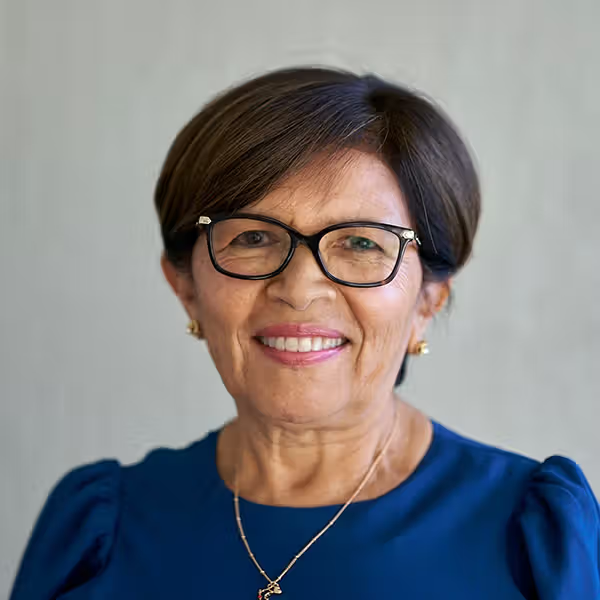
Dr. Carmen Gauthier
Professor Emeritus, Florida Southern College
Lessons Learned About Mentoring and Science from Jack Spencer
Abstract
Jack Spencer’s career included pharmaceutical research, leadership, and teaching. In this presentation, I will highlight his remarkable journey as an organic chemist and his significant contributions to the development of antibiotics during his tenure at Eli Lilly from the 1960s through the 1980s. Beyond his scientific achievements, Jack was an exceptional mentor whose approach to research and collaboration influenced my own work as a faculty member at Florida Southern College. I will share insights into his mentoring philosophy, the lessons I learned from his example, and how his guidance shaped both my scientific perspective and my commitment to supporting the next generation of researchers.
Bio
Dr. Carmen Valdez Gauthier earned her Ph.D. in Chemistry from the University of New Hampshire and completed her undergraduate studies at the Pontifical Catholic University of Peru (PUCP). She joined the faculty of Florida Southern College (FSC) in 1999 after serving at Salem State University and later became the Jessie Ball duPont Chair in the Natural Sciences. She held several leadership roles at FSC, including Chair of the Department of Chemistry, Biochemistry, and Physics and Chair of the Division of Natural Sciences and Mathematics. She is now Professor Emerita.
Dr. Gauthier’s research centers on metal–organic materials, and she has presented and published her work nationally and internationally. Her efforts have been supported by the Flinn Scientific Foundation, the Petroleum Research Fund, the Community Foundation of Greater Lakeland, and Florida Southern College.
A dedicated educator and leader, Dr. Gauthier received the Omicron Delta Kappa Teacher of the Year Award in 2006 and was named an American Chemical Society (ACS) Fellow in 2018. She also received a Fulbright Scholar Award in 2016 to teach and conduct research at PUCP in Lima, Peru.
Dr. Gauthier has been deeply involved in ACS leadership, including service on the Committee on Community Activities, the Membership Affairs Committee, and seven years on the Society Committee on Education (SOCED), where she served as both Vice Chair and Chair. She currently serves on the Committee on Committees (ConC), chairing its Subcommittee on the Committee Appointment System and acting as liaison to the Committees on Ethics and International Activities. She also served on the ACS Exams Institute Board of Trustees and the Advisory Board for High School Chemistry Clubs.
Since 2022, Dr. Gauthier has served on the Board of the Mid-Florida Chapter of the Fulbright Association, where she was Secretary until May 2025 and now serves as President. She continues to collaborate actively with her Fulbright host institution in Peru, contributing to ongoing publications and invited presentations.
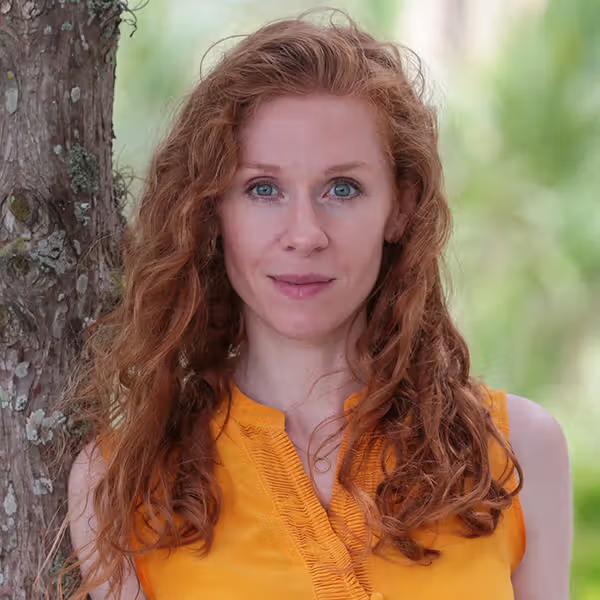
Dr. Kaitlyn Crawford
Associate Professor of Materials Science and Engineering, University of Central Florida
Push-pull Chromophores with a Twist
Abstract
This seminar introduces research activities in the Crawford Lab as a segue to dial in on a discussion about push-pull chromophores toward non-linear electro-optics applications. Dr. Crawford’s lab focuses on developing stimuli-responsive materials for human sustainability; from synthesizing new monomers from renewable resources to designing flexible electronics, piezoelectrics, hydrogels, and electro-optic (EO) materials. In the latter case, push-pull chromophores exhibit useful EO properties with the potential to significantly improve non-linear EO applications ranging from telecommunications to quantum informatics. Compounds with large hyperpolarizability values (β) that are stable and have easily modifiable functional groups are needed to advance organic-based EO systems. This seminar focuses on describing the experimental and theoretical methods we use to investigate the design, synthesis, and potential applications of a new class of push-pull, twist chromophores with xanthene bridges toward non-linear EO applications. A “twist” in the seminar topic includes concluding comments about managing health and well-being in STEM and tools for successful work-life balance.
Bio
Dr. Crawford is an Associate Professor of Materials Science and Engineering (MSE) at the University of Central Florida with affiliations in UCF’s Biionix Cluster, Department of Chemistry, NanoScience and Technology Center (NSTC), and Biomedical Engineering and Sciences programs. Dr. Crawford’s research focuses broadly on identifying new materials (usually polymers) for sensing applications that are environmentally sustainable. Dr. Crawford is a contributing author on several peer-reviewed articles and has received more than 12 awards related to research and teaching since 2009. In addition to directing her research program, she led the development of UCF’s bachelor's degree program in Materials Science and Engineering, which recently welcomed its third cohort of students. It is the second BS-MSE degree program in Florida’s 12 university, State University System. Prior to UCF, Dr. Crawford studied bioelectronics during her postdoc at UIUC and Northwestern with John Rogers (2015-2017). She completed her Ph.D. in Chemistry from the University of Maryland, College Park with Larry Sita (2011-2015), an M.S. in Chemistry from North Carolina State University with Chris Gorman (2009-2011), and B.S. degrees in Psychology and Chemistry from the University of North Carolina at Charlotte (2003-2009).
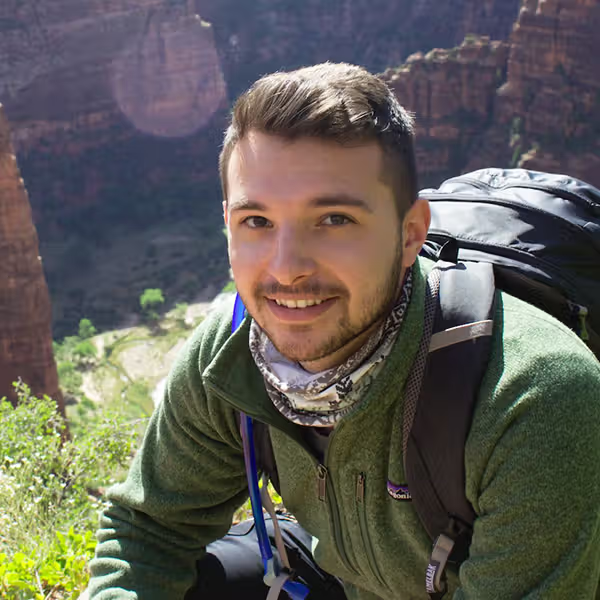
John Zinno
Sr. Genomics Data Scientist, New York Genome , FSC - Class of 2016Center & Weill Cornell Medicine
Exploring the Power of Machine Learning for Applications in Genomics and Bioinformatics
Abstract
As we age, our cells gradually acquire new mutations, creating a patchwork of slightly different cell populations within our tissues. Some of these changes are harmless, while others can alter how cells behave and may contribute to disease. In this talk, I will describe our efforts to understand how these mutations arise and spread over time, and how we can detect them without invasive procedures.
I will first highlight recent work mapping the evolutionary history of cells in the aging human esophagus using single-cell DNA sequencing at unprecedented scale. This project was both a major technical achievement and a source of new biological insights into how normal tissues change with age. I will then discuss the next generation of “liquid biopsy” technologies developed in our group, which analyze DNA fragments circulating in the blood. By improving sequencing accuracy and using new types of information in these DNA fragments, we can detect extremely rare mutations. While these methods are well known for cancer monitoring, we are extending them to identify other conditions, such as tissue damage in organs like the liver, by tracking mutation patterns specific to different tissues.
Finally, I will describe how we use computer simulations and statistical models to estimate how quickly different cell populations grow or shrink over time. By combining these models with large datasets, we can make fast, well-calibrated predictions about cell behavior. Overall, this work aims to better understand how mutations shape aging and disease, and to develop practical, non-invasive tools to measure these processes in people.
Bio
John Zinno received Bachelors of Science degrees in Chemistry and Biology from Florida Southern College in 2016. He received a Masters of Science degree in Biochemistry and Cell Biology from Stony Brook University in 2017 and a Masters of Science degree in Bioinformatics from New York University in 2022. Currently Mr. Zinno works as a Sr. Genomics Data Scientist at New York Genome Center & Weill Cornell Medicine. He is very interested in the use of machine learning / deep learning in applications that include genomics and bioinformatics. Recent work particularly emphasizes the use of Bayesian and generative models to analyze single-cell multiomics data towards understanding somatic mosaicism and characterizing genotype-phenotype relationships.
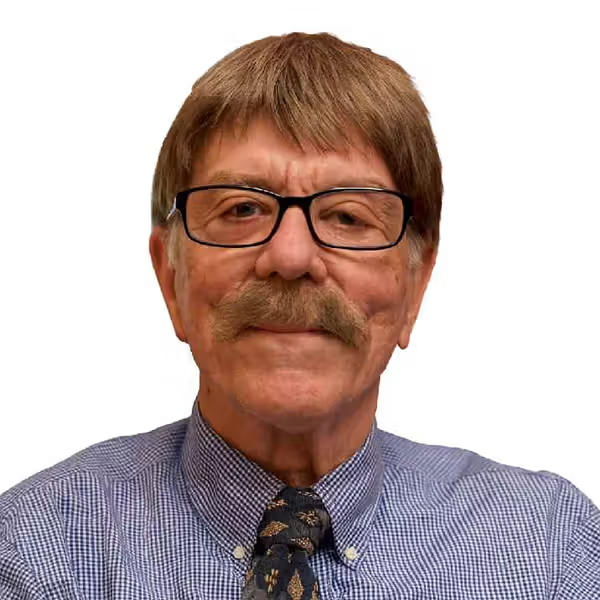
Dr. Wayne Guida
Professor of Chemistry, University of South Florida
Inhibition of the STING Receptor Using Sub-Femtomolar Concentrations of Clonixeril
Abstract
STING (Stimulator of interferon genes) is a transmembrane endoplasmic reticulum resident protein involved in innate immunity. Human STING (hSTING) activation occurs by binding of cyclic guanosine-(2'→5')-monophosphate-adenosine-(3'→5')-monophosphate (abbrev. 2’,3’-cGAMP) to hSTING, which leads to downstream production of interferon alpha and beta. We have discovered that a small molecule named clonixeril (CXL) is the most potent non-nucleotide hSTING modulator reported to date. To do this, we generated molecular dynamics (MD) equilibrated agonist and antagonist models of human STING for computer‑based screening. We then used these models to computationally screen large libraries of commercially available compounds. In vitro and in cellulo methods were then employed and they show that CXL has two modes of interaction with hSTING, one with an EC50 above 1 nM and the other with an EC50 in the 1 fM - 100 aM range (10-15–10-16 M). Unexpectedly, in cell‑based experiments, when CXL is titrated below 1 nM, it displays inverse dose dependent antagonistic behavior toward hSTING. We have substantiated that CXL displays this exceptionally strong inhibitory effect on hSTING mediated interferon production using a THP‑1 cell luciferase reporter for interferon regulatory factor 3 (IRF3) and other cell-based assays using HEK-293 cells.
Bio
Dr. Guida completed the B.A. degree in Chemistry and Ph. D. in Organic Chemistry at USF. After leaving USF, Dr. Guida pursued post-doctoral studies at Duke University. Dr. Guida then taught and conducted research with undergraduates at Eckerd College in St. Petersburg, Florida. After spending six years at Eckerd College, Dr. Guida departed to pursue further postdoctoral studies at Columbia University in the City of New York. His work at Columbia in 1985-86 as a Senior Research Fellow with Professor W. Clark Still led to the development of the MacroModel computational modeling software still used to this day in academia and industry. Dr. Guida’s work at Columbia subsequently led to an industrial position in pharmaceutical research. After Columbia, Dr. Guida joined Ciba-Geigy Pharmaceuticals in Summit, New Jersey doing computer-guided drug discovery. He was eventually appointed to the position of Executive Director of Biomolecular Structure, Lead Finding, and Computing at the Novartis Institute for Biomedical Research where he supervised a group of scientists engaged in computational molecular modeling, structural bioinformatics, X-ray crystallography, protein NMR spectroscopy, protein biochemistry, and high-throughput screening. In 2001, Dr. Guida became affiliated with the Drug Discovery Program at the H. Lee Moffitt Cancer Center & Research Institute and in 2007 he joined the chemistry faculty at USF. Dr. Guida maintains an appointment at Moffitt as a Collaborator Member in the Chemical Biology and Molecular Medicine Programs to this day. From 2015-2019, Dr. Guida served as Chair of the Chemistry Department at USF. Both at Moffitt and USF, Dr. Guida and his students have focused on discovering novel drugs for the treatment of cancer, cardiovascular disease, infectious diseases and autoimmune disease. Dr. Guida teaches organic chemistry, medicinal chemistry, and biochemistry courses to undergraduates and graduate students at USF. Dr. Guida has been a member of the American Chemical Society since he was an undergraduate student and in 2018, he was elected as a Fellow of the American Association for the Advancement of Science (AAAS).